Application of Xylanase in Food Industry for Baking
Xylanase for industrial bakeries and premix makers: dosage, pH, temperature, QC, COA/TDS/SDS, pilot validation, and supplier qualification guidance.
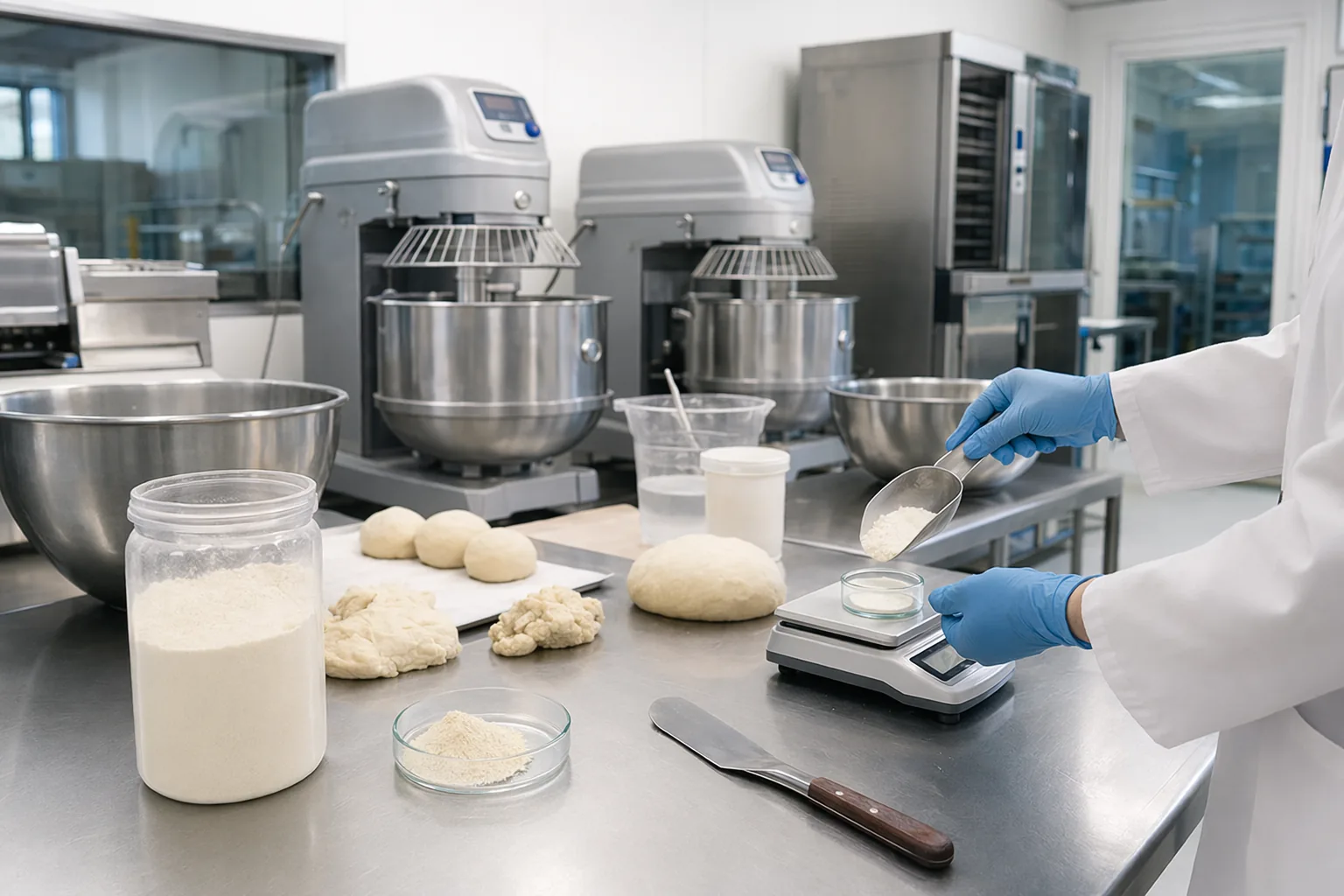
A practical buyer guide for bakeries, premix manufacturers, and enzyme distributors evaluating xylanase for dough handling, loaf volume, crumb quality, and cost-in-use. To request a quote, send the product, quantity and destination through the form on the home page.
Why Xylanase Matters in Industrial Baking
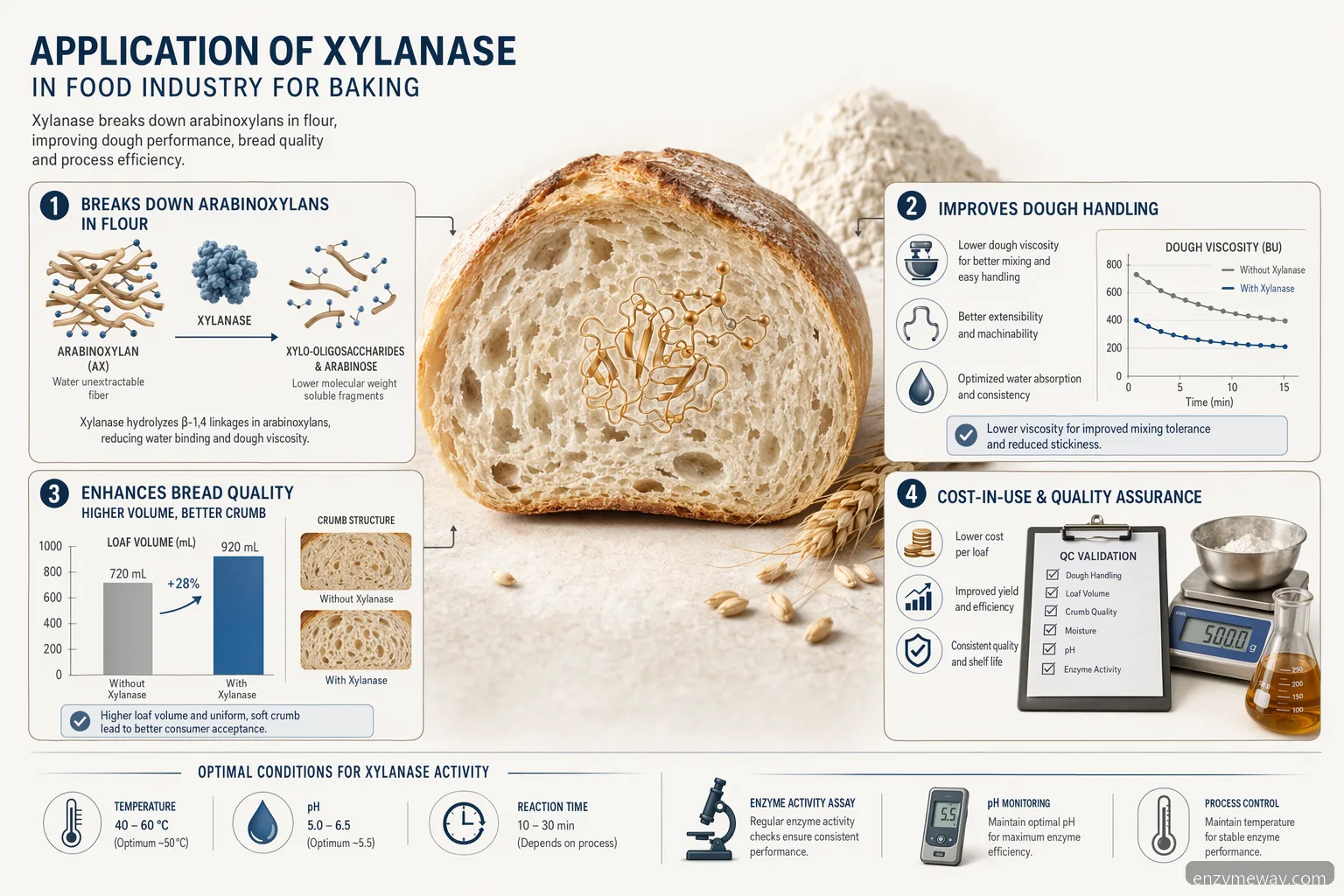
The application of xylanase in food industry processes is especially valuable in baking because wheat flour contains arabinoxylans, a major hemicellulose fraction that binds water and influences dough structure. A xylanase enzyme hydrolyzes selected xylan linkages, helping redistribute water, improve dough extensibility, and support gas cell stability during proofing and baking. For high-speed bread, buns, rolls, tortillas, and frozen dough systems, this can translate into easier machining, improved loaf volume, finer crumb, and more consistent batch performance. Buyers should treat xylanase in food as a process aid or functional processing enzyme, not as a medical or nutritional supplement. Performance depends on flour quality, formulation, mixing energy, fermentation time, oxidants, emulsifiers, and other enzymes in the improver blend. The best commercial result comes from controlled trials that connect enzyme dosage to measurable quality outcomes and production economics.
Relevant for bread, buns, rolls, pizza bases, crackers, and flour improvers • Used to support dough handling, volume, crumb softness, and processing tolerance • Must be optimized with flour quality and the complete formulation
What Is Xylanase in Food and How Does It Work?
For buyers asking what is xylanase in food, it is an industrial enzyme used to hydrolyze xylan-containing hemicellulose, mainly arabinoxylans in cereal-based systems. The wider category of hemicellulose-degrading enzymes is covered on this separate page about commercial hemicellulase sourcing. In wheat dough, water-unextractable arabinoxylans can interfere with gluten network development and gas expansion. Controlled xylanase activity can partially solubilize these polymers, improving water distribution and dough elasticity without over-weakening the dough. In practical baking, the use of xylanase in food industry applications is not about maximum hydrolysis; it is about controlled modification within the available process window. Enzyme activity is influenced by pH, temperature, water availability, flour ash, bran level, salt, sugar, fat, and fermentation time. For most yeast-leavened doughs, the enzyme acts during mixing, resting, proofing, and early oven heating before thermal inactivation. Overdosing may cause sticky dough, weak structure, or reduced tolerance, so small-step trials are essential.
Primary substrate: cereal arabinoxylans and related hemicellulose fractions • Main process window: mixing through early baking • Optimization target: controlled dough improvement, not excessive viscosity reduction
Recommended Trial Conditions for Xylanase Baking
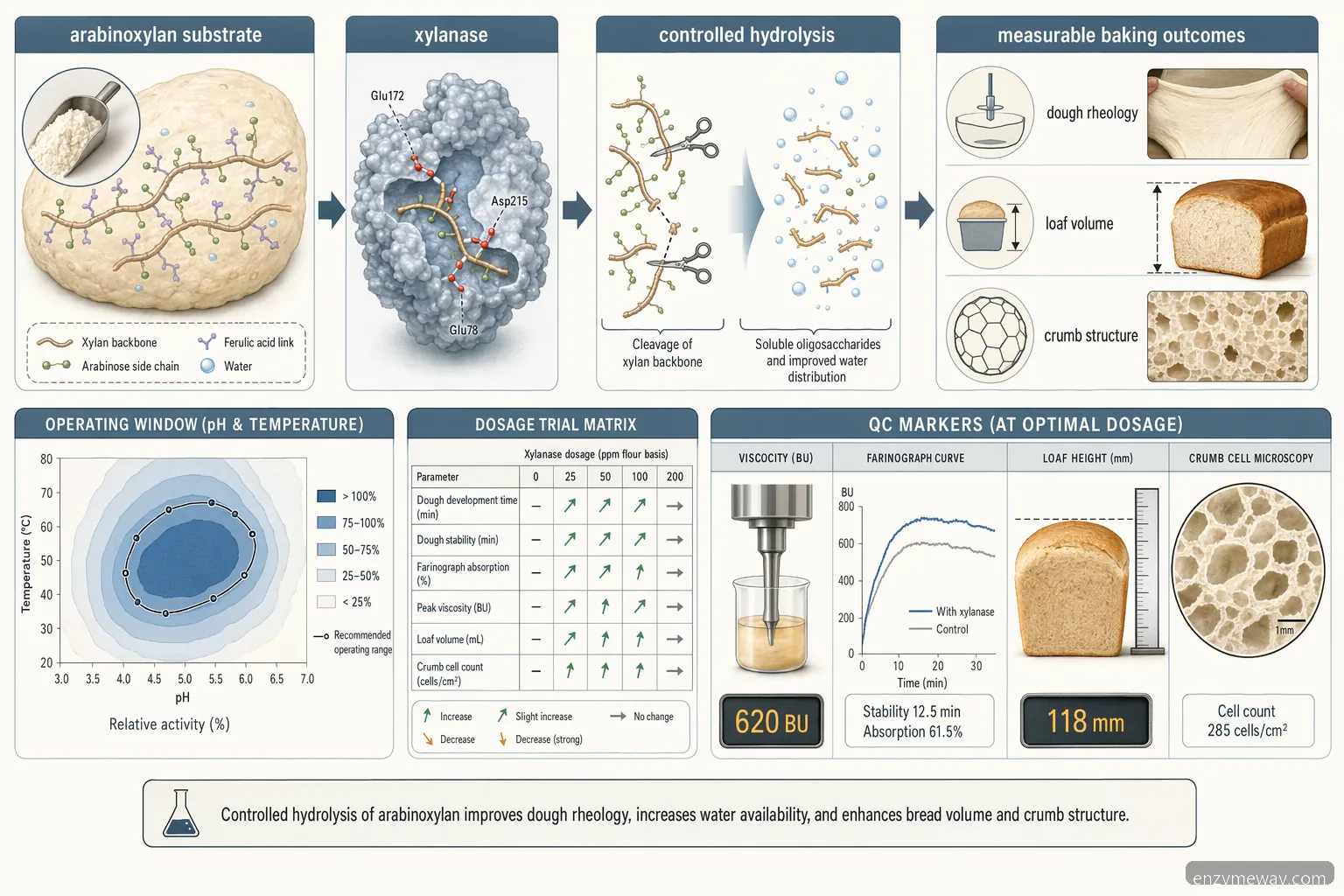
A practical xylanase baking trial should begin with the supplier’s activity definition and recommended dosage band, because activity units are not universally interchangeable. Many bakery trials start in a low ppm range on flour weight, commonly around 5 to 100 ppm for concentrated commercial preparations, then adjust based on enzyme strength and formulation. Typical dough pH is about 4.5 to 6.5, while many fungal xylanases show useful activity in the mildly acidic to near-neutral range. Dough processing temperatures are usually 20 to 35°C, with additional activity during proofing and early oven spring until heat inactivation occurs. Pilot tests should compare a control, a low dose, a mid dose, and a high dose. Record water absorption, mix time, dough stickiness, proof height, loaf volume, crumb grain, sliceability, and sensory notes. Cost-in-use should be calculated per metric ton of flour or finished product.
Start with supplier-recommended ppm dosage based on flour weight • Evaluate at least three dosage levels plus a no-enzyme control • Track both processing benefits and finished product quality • Calculate cost-in-use before commercial approval
QC Checks and Commercial Validation
For reliable xylanase in food industry production, quality control should cover both incoming enzyme lots and bakery performance. Incoming checks may include appearance, activity assay confirmation, moisture for dry products, microbial limits where relevant, packaging integrity, lot number, manufacture date, and storage conditions. The COA should match the delivered batch, while the TDS should define activity units, recommended use range, pH and temperature profile, carrier information, handling guidance, and shelf-life conditions. The SDS should support safe warehouse and production handling. During pilot validation, use the same flour source, mixer type, mixing energy, fermentation profile, and oven settings expected at scale. Include stress tests for flour variation, delayed processing, and over-proofing. A technically sound supplier will help interpret results, adjust dosage, and avoid unnecessary enzyme stacking that increases cost without improving measurable product quality.
Request COA, TDS, SDS, batch traceability, and storage guidance • Verify activity-unit definition before comparing suppliers • Use production-relevant flour, equipment, and process timing • Confirm shelf-life and performance under real plant conditions
Specific Uses of Xylanase in Food Industry Baking
The specific uses of xylanase in food industry baking vary by product format. In pan bread, xylanase can support loaf volume, crumb uniformity, and dough tolerance. In buns and rolls, it may improve machining and reduce variability during dividing, rounding, and proofing. In whole wheat, rye-containing, or high-fiber formulas, xylanase can help manage water-binding hemicellulose and improve dough consistency, although bran particle size and fiber source strongly affect results. In frozen dough, enzyme selection must be cautious because long holding times can amplify activity and change dough strength after thawing. In crackers and flatbreads, the target may be sheeting behavior and bite texture rather than loaf volume. For improver manufacturers, xylanase is often blended with amylase, glucose oxidase, lipase, or emulsifiers, but compatibility must be proven through side-by-side trials rather than assumed from general enzyme descriptions.
Pan bread: volume, crumb grain, and proof tolerance • Buns and rolls: machinability and batch consistency • High-fiber formulas: water management and dough handling • Frozen dough: careful dosage to prevent activity drift
Beyond Baking: Paper, Pulp, Feed, and Biofuel Relevance
Although this page focuses on application of xylanase in food industry baking, the same enzyme class is widely used in other industrial processes. The application of xylanase in paper and pulp industry operations is typically linked to pulp pre-bleaching, where xylanase can help release lignin-carbohydrate complexes and reduce chemical demand under controlled mill conditions. Xylanase in paper industry use requires different specifications from bakery products, including process pH, temperature stability, metal ion tolerance, and compatibility with pulp chemistry. In animal feed, xylanase is used to reduce the anti-nutritional effect of arabinoxylans in cereal-rich diets and improve nutrient availability. In biofuel, xylanase supports hemicellulose conversion as part of biomass hydrolysis systems. Buyers should select the grade, activity profile, and regulatory documentation according to the intended application, because a baking enzyme specification is not automatically suitable for pulp, feed, or biomass processing.
Baking grade selection should prioritize food-use documentation and dough performance • Pulp and paper applications require different pH, temperature, and process compatibility • Feed and biofuel uses need application-specific activity profiles and documentation
Technical Buying Checklist
Buyer Questions
The main application is controlled modification of cereal arabinoxylans in flour-based doughs. In industrial baking, xylanase can improve water distribution, dough handling, gas retention, loaf volume, crumb structure, and processing tolerance. Results depend on flour quality, formulation, dosage, fermentation time, and other improver components, so buyers should validate performance through controlled pilot baking trials before plant-wide use.
A bakery should qualify suppliers based on technical documentation, batch consistency, application support, traceability, and responsiveness during trials. Ask for COA, TDS, SDS, activity-unit definition, recommended dosage, storage conditions, and food-use documentation where applicable. A strong supplier should help design pilot tests, interpret baking data, optimize dosage, and support cost-in-use comparison without making unsupported claims.
Dosage depends on enzyme activity, product concentration, flour quality, and baking target. Many concentrated xylanase products are initially trialed in a low ppm range based on flour weight, often around 5 to 100 ppm, but supplier guidance must be followed because activity units vary. Trials should include a no-enzyme control and multiple dosage levels to identify the best performance-to-cost ratio.
Yes, xylanase is often used with amylase, lipase, glucose oxidase, protease, or emulsifier systems in bakery improvers. However, combinations can create synergy or imbalance. For example, too much hemicellulose modification may cause sticky or weak dough. Each blend should be tested under the actual flour, mixing, proofing, and baking conditions used in production.
No. Xylanase is also used in animal feed, pulp and paper, and biofuel processing. Xylanase in paper industry applications may support pulp pre-bleaching under mill-specific pH and temperature conditions, while feed and biomass applications require different performance profiles. Buyers should avoid assuming one grade fits all uses and should request application-specific specifications and documentation.
Related Search Themes
xylanase, xylanase in food industry, use of xylanase in food industry, specific uses of xylanase in food industry, application of xylanase in paper and pulp industry, xylanase in food
Request a Quote: Wholesale Supply for Bakeries, Improver Makers and Resellers
We supply xylanase to industrial bakeries, flour-improver and premix makers, ingredient distributors and resellers on a quote basis. The product on this site is Xylanase Enzyme Powder (EC 3.2.1.8): a light tan to brown powder in activity grades of 10,000 – 100,000 U/g, packed in 25 kg fiber drums or custom packaging. Prices are quoted per order.
To get a quote, send three things: the product and activity grade, the quantity per order or per month, and the destination country or port. Add your application and process conditions if you also want trial guidance with the quote.
Use the quote form on the home page or email hello@mail.enzymeway.com.
Xylanase for Research & Industry
Need Xylanase for your lab or production process?
ISO 9001 certified · Food-grade & research-grade · Ships to 80+ countries
Frequently Asked Questions
What is the main application of xylanase in food industry baking?
The main application is controlled modification of cereal arabinoxylans in flour-based doughs. In industrial baking, xylanase can improve water distribution, dough handling, gas retention, loaf volume, crumb structure, and processing tolerance. Results depend on flour quality, formulation, dosage, fermentation time, and other improver components, so buyers should validate performance through controlled pilot baking trials before plant-wide use.
How should a bakery choose the right xylanase enzyme supplier?
A bakery should qualify suppliers based on technical documentation, batch consistency, application support, traceability, and responsiveness during trials. Ask for COA, TDS, SDS, activity-unit definition, recommended dosage, storage conditions, and food-use documentation where applicable. A strong supplier should help design pilot tests, interpret baking data, optimize dosage, and support cost-in-use comparison without making unsupported claims.
What dosage of xylanase is used in bread production?
Dosage depends on enzyme activity, product concentration, flour quality, and baking target. Many concentrated xylanase products are initially trialed in a low ppm range based on flour weight, often around 5 to 100 ppm, but supplier guidance must be followed because activity units vary. Trials should include a no-enzyme control and multiple dosage levels to identify the best performance-to-cost ratio.
Can xylanase be combined with other bakery enzymes?
Yes, xylanase is often used with amylase, lipase, glucose oxidase, protease, or emulsifier systems in bakery improvers. However, combinations can create synergy or imbalance. For example, too much hemicellulose modification may cause sticky or weak dough. Each blend should be tested under the actual flour, mixing, proofing, and baking conditions used in production.
Is xylanase used only in the food industry?
No. Xylanase is also used in animal feed, pulp and paper, and biofuel processing. Xylanase in paper industry applications may support pulp pre-bleaching under mill-specific pH and temperature conditions, while feed and biomass applications require different performance profiles. Buyers should avoid assuming one grade fits all uses and should request application-specific specifications and documentation.
Ready to source?
Turn This Guide Into a Supplier Brief Contact EnzymeWay to request xylanase COA/TDS/SDS, bakery trial guidance, and a cost-in-use quotation for your flour or premix application.
Contact Us to Contributehello@mail.enzymeway.com