Production of Xylanase for Industrial Applications
B2B guide to production of xylanase: fermentation routes, process conditions, QC, applications, cost-in-use, and supplier qualification.
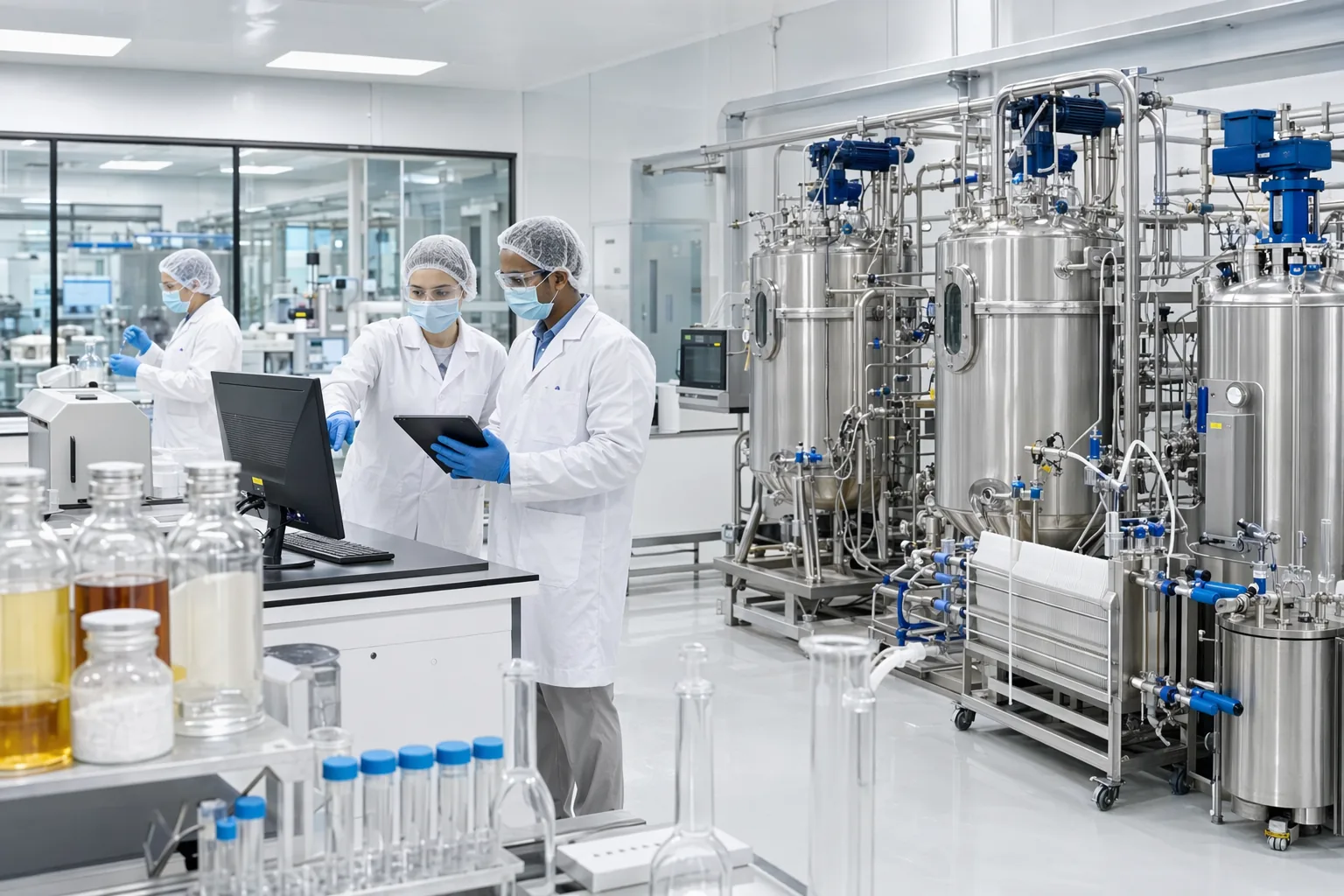
A practical buyer’s guide to xylanase production, specification review, pilot validation, and cost-in-use evaluation for baking, feed, pulp, and biofuel operations. To request a quote, send the product, quantity and destination through the form on the home page.
What Industrial Xylanase Production Involves
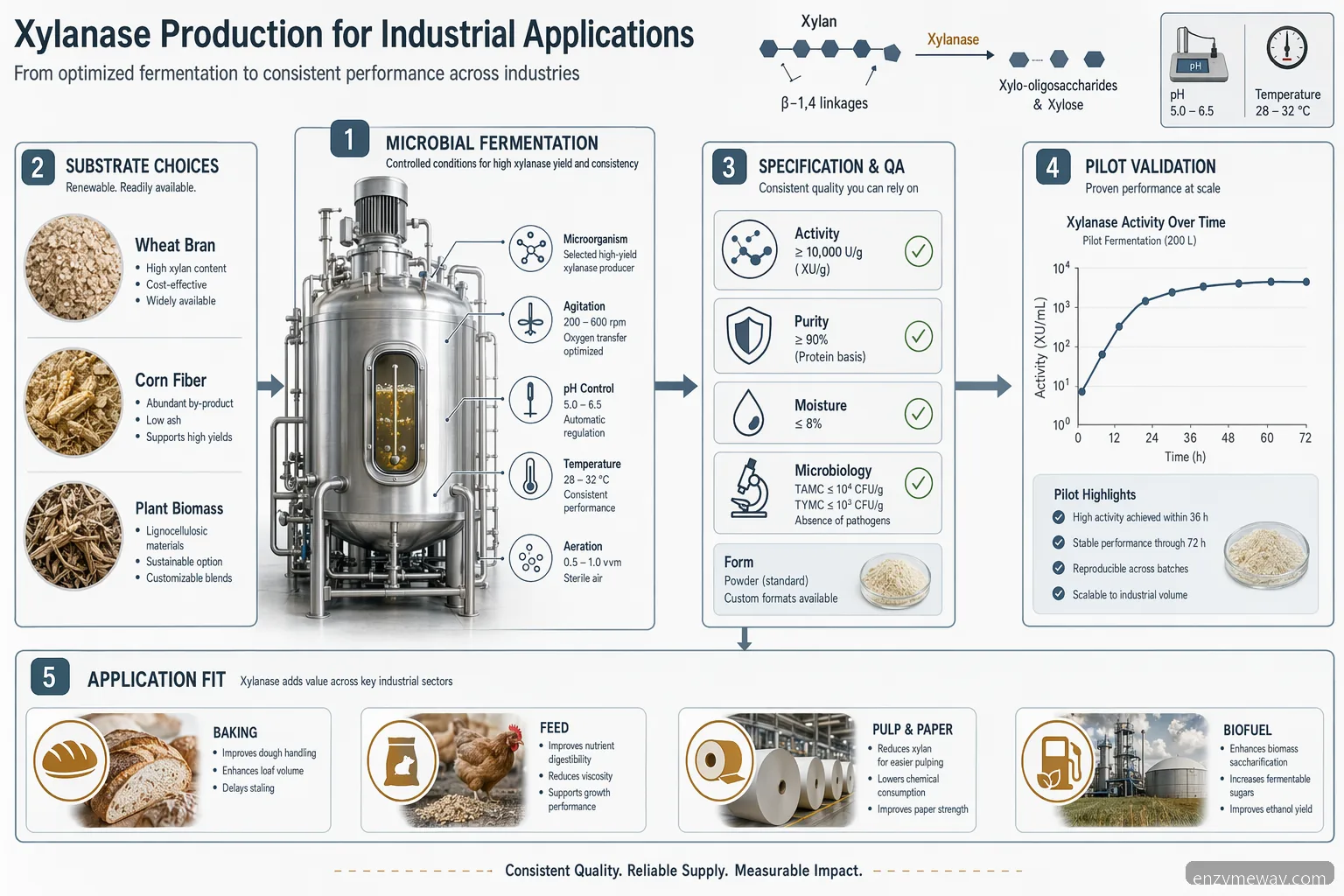
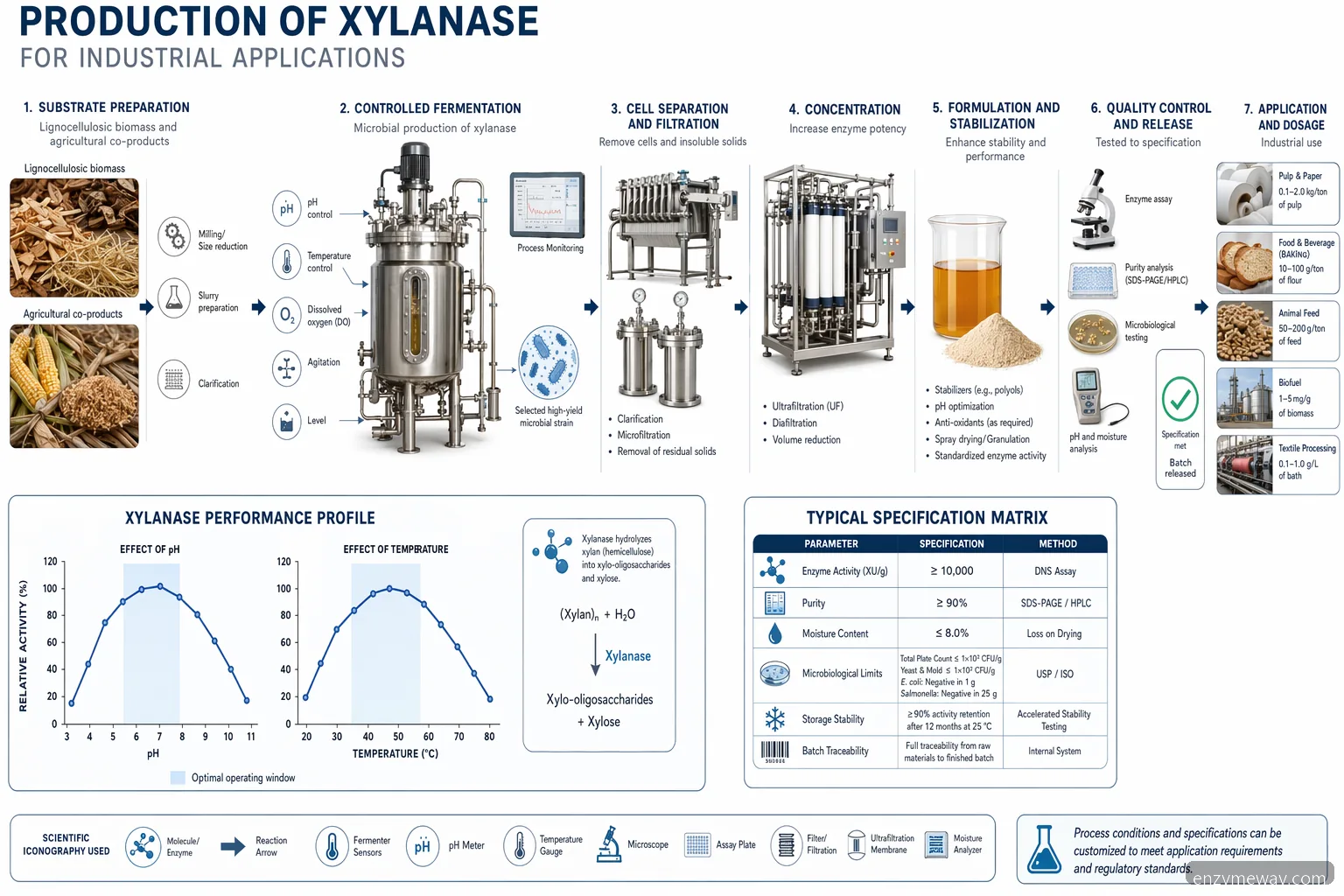
The production of xylanase starts with selecting a microbial source capable of secreting xylanase enzyme into a fermentation broth. Commercial xylanase production commonly uses fungal or bacterial strains, selected for activity profile, thermostability, pH tolerance, and low unwanted side activities. The process generally includes inoculum preparation, submerged or solid-state fermentation, downstream clarification, concentration, stabilization, and final formulation as liquid or powder. For B2B buyers, the key question is not only how the enzyme is made, but whether the resulting activity matches the production line where it will be used. Baking may need dough-friendly activity at moderate temperature, animal feed may require pelleting stability, pulp and paper may require alkaline tolerance, and biofuel operations may need compatibility with biomass pretreatment and saccharification steps.
Typical formats: liquid concentrates, granules, and spray-dried powders • Core documents: COA, TDS, SDS, allergen or handling statements where applicable • Primary evaluation metric: performance per unit of finished product, not only price per kilogram
Fermentation Routes and Substrate Choices
Xylanase enzyme production from bacteria and fungi can be performed by submerged fermentation, solid-state fermentation, or hybrid development routes. Submerged fermentation is widely used for scalable control of pH, aeration, agitation, feed rate, foam, and contamination risk. Solid-state fermentation can be attractive when using agricultural residues, including wheat bran, corn cob, rice bran, sugarcane bagasse, or sorghum straw for xylanase hyper production studies. In commercial procurement, buyers should distinguish laboratory yield reports from validated industrial supply. Media composition, inducer source, sterilization method, and downstream recovery strongly affect reproducibility. Xylan-rich substrates may support higher expression, but the final enzyme must still be standardized to a defined activity, moisture, microbiological limit, and storage stability profile before use in regulated manufacturing environments.
Submerged fermentation supports tighter process control and lot consistency • Agricultural residues may reduce substrate cost but require contaminant control • Pilot data should confirm scalability beyond shake flask or tray trials
Typical Process Conditions and Controls
Process conditions for xylanase production vary by organism and plant design, but safe evaluation ranges can guide technical discussions. Many production fermentations are run around pH 4.5–7.5 and 25–40°C for fungal systems, while bacterial routes may use pH 6.0–8.0 and 30–45°C, depending on strain robustness. Application performance is often tested at pH 4.0–7.0 and 40–65°C, with thermostable grades evaluated at higher short-time exposures. Dosage bands also vary: baking trials may begin at tens to hundreds of enzyme units per kilogram of flour, feed applications may be dosed per metric ton of complete feed, and biomass hydrolysis may be optimized against dry substrate load. Controls should include activity assay, protein profile, bioburden, moisture, pH, heavy metals if relevant, and stability under storage.
Confirm the activity unit definition before comparing suppliers • Run temperature and pH mapping under your real process conditions • Check lot-to-lot variation and shelf-life claims with retained samples
Application Fit: Baking, Feed, Paper, and Biofuel
A xylanase enzyme that performs well in one application may not be optimal in another. In xylanase baking, the goal is usually to modify arabinoxylans to improve dough handling, loaf volume, crumb structure, or processing tolerance without causing stickiness. In xylanase animal feed, the enzyme targets non-starch polysaccharides to support nutrient availability, with stability during premixing, pelleting, and storage being critical. In pulp and paper, xylanase can assist bleaching sequences by modifying hemicellulose in pulp, potentially reducing chemical intensity depending on the mill process. Xylanase in biofuel production is used to increase hemicellulose accessibility and support sugar release during biomass conversion. For xylose production exo xylanase activity may be relevant, but buyers should specify whether they need endo-xylanase, exo-xylanase, beta-xylosidase, or a blended hemicellulase system.
Baking: validate dough rheology, volume, crumb, and handling • Feed: validate pelleting recovery, digestibility targets, and premix compatibility • Biofuel: validate sugar yield, inhibitor tolerance, and synergy with cellulase
Quality Documentation and Supplier Qualification
Before approving a xylanase supplier, request a current certificate of analysis, technical data sheet, safety data sheet, recommended storage conditions, shelf-life statement, activity method, and batch coding system. The COA should match the commercial grade being purchased, not a generic enzyme category. Review whether the producer can support pilot validation, retain samples, change notification, and consistent supply volumes. Supplier qualification should also consider manufacturing control, traceability, packaging integrity, technical support, and responsiveness during process troubleshooting. Cost-in-use should be calculated using effective dose, yield gain, process savings, waste reduction, and downtime risk rather than enzyme price alone. A well-qualified xylanase enzyme supplier should help translate lab activity into plant performance through structured trials, clear documentation, and realistic dosage recommendations.
Request COA, TDS, SDS, activity method, and storage guidance • Confirm lead time, minimum order quantity, and packaging options • Use pilot validation before locking commercial dosage
QC Checklist: COA, TDS, SDS, and Batch Consistency
A reliable xylanase enzyme supplier should provide current technical documentation for every commercial grade. The Certificate of Analysis should identify batch number, activity result, assay method reference, appearance, moisture or solids where relevant, and release date. The Technical Data Sheet should describe application area, recommended pH and temperature range, storage, shelf life, dosage guidance, and handling notes. The Safety Data Sheet should cover safe industrial handling, dust or aerosol precautions, personal protective equipment, and transport information. Buyers should also request batch-to-batch trend data when the enzyme is critical to output quality. QC checks may include activity assay, microbiological limits where applicable, heavy metal screening if relevant to the application, and stability testing under storage conditions. If the supplier changes formulation, carrier, concentration, or manufacturing site, a technical change notification process should be in place before production use.
Request COA for each batch. • Review TDS for operating window and dosage guidance. • Use SDS for industrial handling controls. • Ask about change notification procedures.
Supplier Qualification for Long-Term Xylanase Supply
Supplier qualification should cover technical capability, documentation quality, communication speed, and supply reliability. Ask how the supplier controls xylanase production, formulation, packaging, storage, and shipment. Confirm whether the product is liquid, powder, granule, or coated form, because this affects dosing equipment, dust control, mixing uniformity, and shelf life. For international purchasing, clarify lead time, minimum order quantity, packaging size, labeling, customs documents, and temperature exposure during transit. Quality agreements may define specification limits, retained samples, complaint handling, and notification timelines for significant process or raw material changes. Buyers should also assess whether the supplier can support multiple applications, such as xylanase baking, xylanase animal feed, pulp and paper, and biofuel, without forcing a single generic grade into every process. A qualified supplier helps convert laboratory activity into stable industrial performance.
Confirm format: liquid, powder, granule, or coated. • Review lead time, MOQ, and packaging options. • Define complaint and change-control expectations. • Prefer suppliers with application-specific support.
Technical Buying Checklist
Buyer Questions
The best method depends on required activity profile, cost target, and scale. Submerged fermentation is often preferred for industrial xylanase production because pH, aeration, agitation, contamination control, and downstream recovery are easier to standardize. Solid-state fermentation may be useful with low-cost agricultural residues, but commercial buyers should verify reproducibility, contamination controls, and finished enzyme specifications before approval.
Start by comparing the activity unit definition, assay conditions, target substrate, and formulation strength. Then review COA, TDS, SDS, stability data, microbiological limits, and packaging controls. A low price per kilogram can be misleading if the activity is lower, the dose is higher, or the enzyme loses performance during storage, pelleting, baking, or process heating.
Dosage must be validated in the buyer’s process. Baking trials may start at low unit-per-kilogram flour levels, while feed products are usually dosed per metric ton and biofuel trials per dry biomass load. The correct dose depends on substrate xylan content, contact time, pH, temperature, moisture, and target result. Always optimize through bench and pilot trials before commercial rollout.
Yes. Xylanase enzyme production from bacteria may deliver different pH tolerance, thermostability, and side-activity profiles than fungal production. Some bacterial xylanases are selected for higher temperature or neutral-to-alkaline conditions, while fungal enzymes are often used in acidic to mildly acidic environments. The source alone does not determine suitability; application testing and specification review are essential.
Pilot validation confirms that the xylanase works under real process conditions, not only in a supplier assay. It helps determine effective dose, mixing behavior, stability, yield effect, product quality, and cost-in-use. Pilot work also reveals compatibility issues with salts, preservatives, pelleting heat, dough improvers, biomass inhibitors, or process chemicals before a full commercial purchase.
Request a Quote: Wholesale Supply for Manufacturers and Resellers
We supply xylanase to bakeries, feed mills, pulp and paper mills, juice and biomass processors, distributors and resellers on a quote basis. The product on this site is Xylanase Enzyme Powder (EC 3.2.1.8): a light tan to brown powder in activity grades of 10,000 – 100,000 U/g, packed in 25 kg fiber drums or custom packaging. Prices are quoted per order.
To get a quote, send three things: the product and activity grade, the quantity per order or per month, and the destination country or port. Add your application and process conditions if you also want trial guidance with the quote.
Use the quote form on the home page or email hello@mail.enzymeway.com.
Xylanase for Research & Industry
Need Xylanase for your lab or production process?
ISO 9001 certified · Food-grade & research-grade · Ships to 80+ countries
Frequently Asked Questions
What is the best method for xylanase production?
The best method depends on required activity profile, cost target, and scale. Submerged fermentation is often preferred for industrial xylanase production because pH, aeration, agitation, contamination control, and downstream recovery are easier to standardize. Solid-state fermentation may be useful with low-cost agricultural residues, but commercial buyers should verify reproducibility, contamination controls, and finished enzyme specifications before approval.
How should buyers compare xylanase enzyme production quality?
Start by comparing the activity unit definition, assay conditions, target substrate, and formulation strength. Then review COA, TDS, SDS, stability data, microbiological limits, and packaging controls. A low price per kilogram can be misleading if the activity is lower, the dose is higher, or the enzyme loses performance during storage, pelleting, baking, or process heating.
What dosage of xylanase should be used in production?
Dosage must be validated in the buyer’s process. Baking trials may start at low unit-per-kilogram flour levels, while feed products are usually dosed per metric ton and biofuel trials per dry biomass load. The correct dose depends on substrate xylan content, contact time, pH, temperature, moisture, and target result. Always optimize through bench and pilot trials before commercial rollout.
Is bacterial xylanase different from fungal xylanase?
Yes. Xylanase enzyme production from bacteria may deliver different pH tolerance, thermostability, and side-activity profiles than fungal production. Some bacterial xylanases are selected for higher temperature or neutral-to-alkaline conditions, while fungal enzymes are often used in acidic to mildly acidic environments. The source alone does not determine suitability; application testing and specification review are essential.
Why is pilot validation important before buying xylanase in bulk?
Pilot validation confirms that the xylanase works under real process conditions, not only in a supplier assay. It helps determine effective dose, mixing behavior, stability, yield effect, product quality, and cost-in-use. Pilot work also reveals compatibility issues with salts, preservatives, pelleting heat, dough improvers, biomass inhibitors, or process chemicals before a full commercial purchase.
How is cost-in-use calculated for xylanase production trials?
Cost-in-use combines enzyme price with the dosage needed to achieve the target result, activity retained during processing, handling losses, storage stability, and the value of process improvements. A valid trial compares products under identical pH, temperature, substrate, mixing, and residence time. The best purchase is usually the enzyme that provides repeatable production benefit at the lowest total operating cost.
Ready to source?
Turn This Guide Into a Supplier Brief Request xylanase specifications, samples, and pilot-trial support for your production line.
Contact Us to Contributehello@mail.enzymeway.com