Xylanase in Baking: How to Use Xylanase in Baking Formulations
Learn how to use xylanase in baking formulations, including dosage, process conditions, QC checks, and supplier qualification.
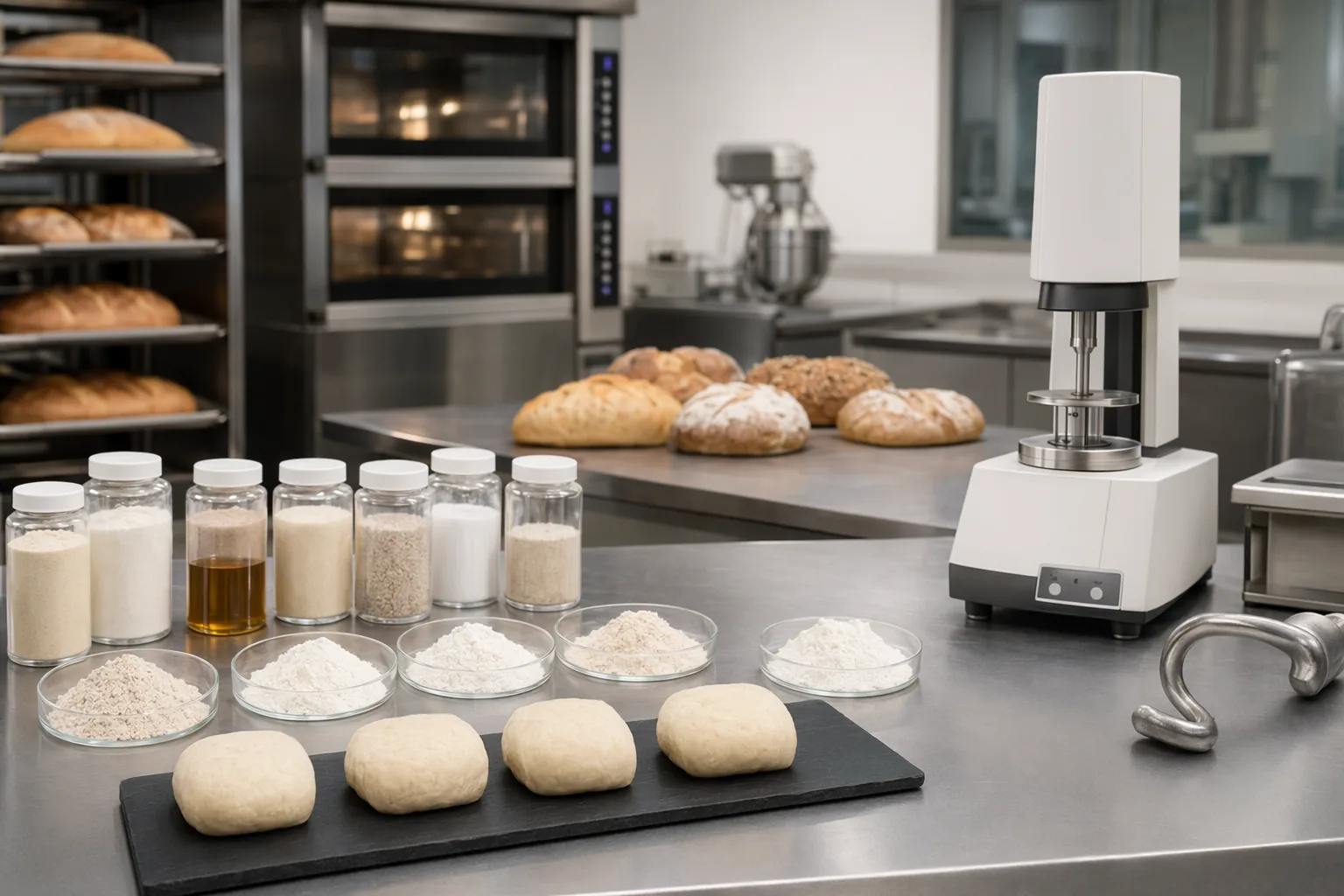
For industrial bakeries and premix manufacturers, xylanase can improve dough handling and finished bread quality when selected, dosed, and validated against flour variability. To request a quote, send the product, quantity and destination through the form on the home page.
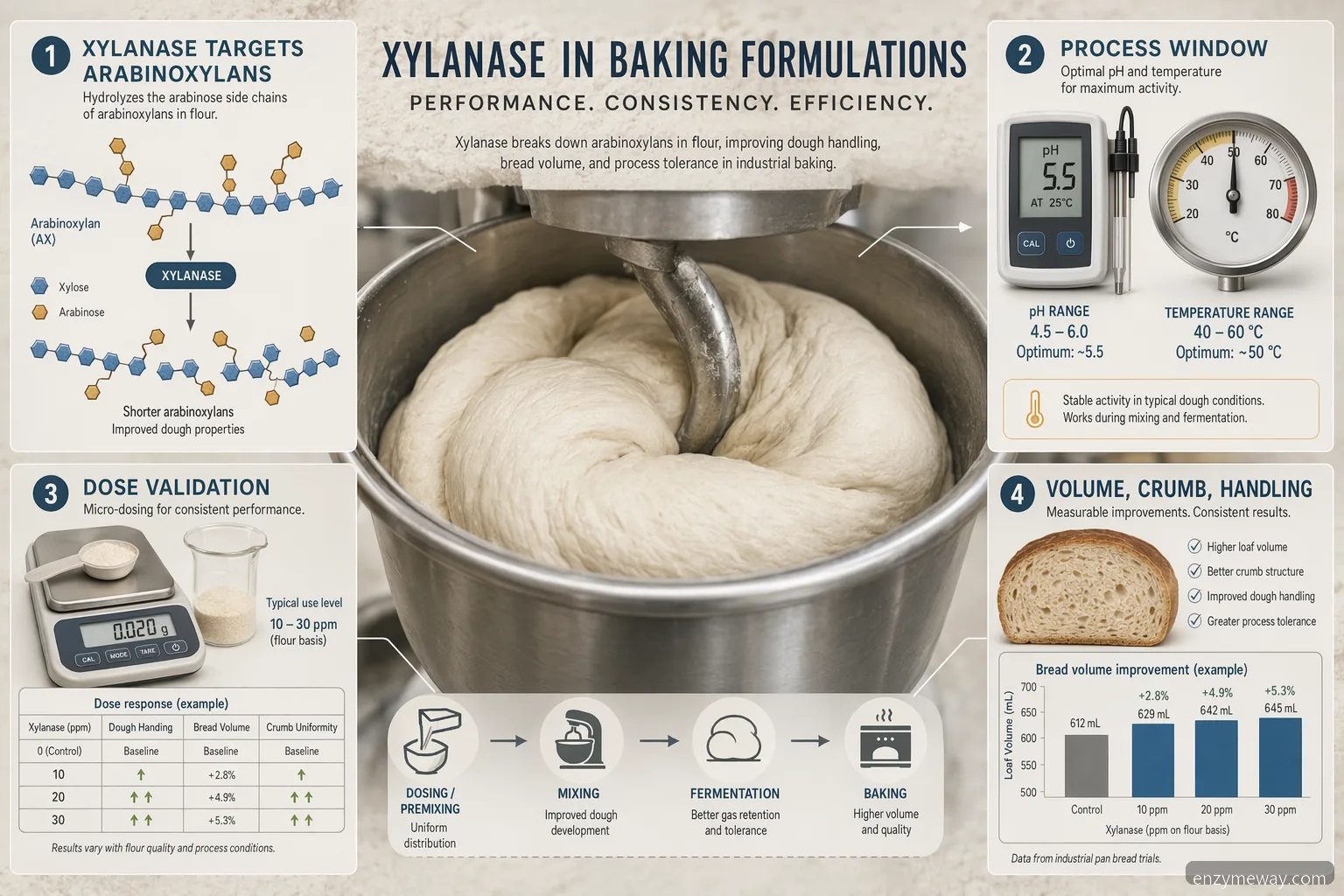
What Xylanase Does in Baking Formulations
Xylanase is an industrial enzyme used in bakery systems to partially hydrolyze arabinoxylans, a class of non-starch polysaccharides found in wheat flour and bran fractions. In controlled amounts, the xylanase enzyme can help redistribute water, reduce excessive dough resistance, and improve gas cell stability during mixing, proofing, and early baking. For pan bread, buns, rolls, and some laminated or fermented products, this may support better dough handling, loaf volume, crumb uniformity, and softness. The effect depends strongly on flour ash level, pentosan content, damaged starch, gluten strength, absorption, and fermentation time. Xylanase for baking should therefore be treated as a formulation tool, not a universal additive. Industrial users should evaluate it alongside oxidants, emulsifiers, amylases, lipases, and yeast performance to avoid over-softening, sticky dough, or loss of tolerance.
Primary substrate: wheat arabinoxylans and soluble pentosans • Main formulation goal: controlled dough rheology and crumb improvement • Best evaluated in the full flour, yeast, water, and improver system
Recommended Process Conditions and Dosage Ranges
Most bakery xylanase products are selected for activity under dough conditions rather than high-temperature processing. As a practical starting point, test xylanase in baking at 20–200 g of commercial enzyme product per metric ton of flour, or follow the supplier’s declared activity-based dosage if available. Dough pH is commonly around 5.0–6.2, which is suitable for many fungal xylanase preparations, while mixing and proofing temperatures often range from 20–40°C. Enzyme action occurs mainly during hydration, mixing, resting, and proofing. During baking, xylanase is progressively inactivated as crumb temperature rises, commonly above 70–90°C depending on enzyme source and product design. Because products vary widely in activity units, carrier, granulation, and side activities, dosage should be confirmed through pilot trials rather than transferred directly from another supplier or bakery line.
Trial band: 20–200 g product per metric ton of flour • Typical dough pH: 5.0–6.2 • Typical action window: mixing, resting, proofing, and early oven spring • Avoid scale-up without activity-based comparison and pilot baking
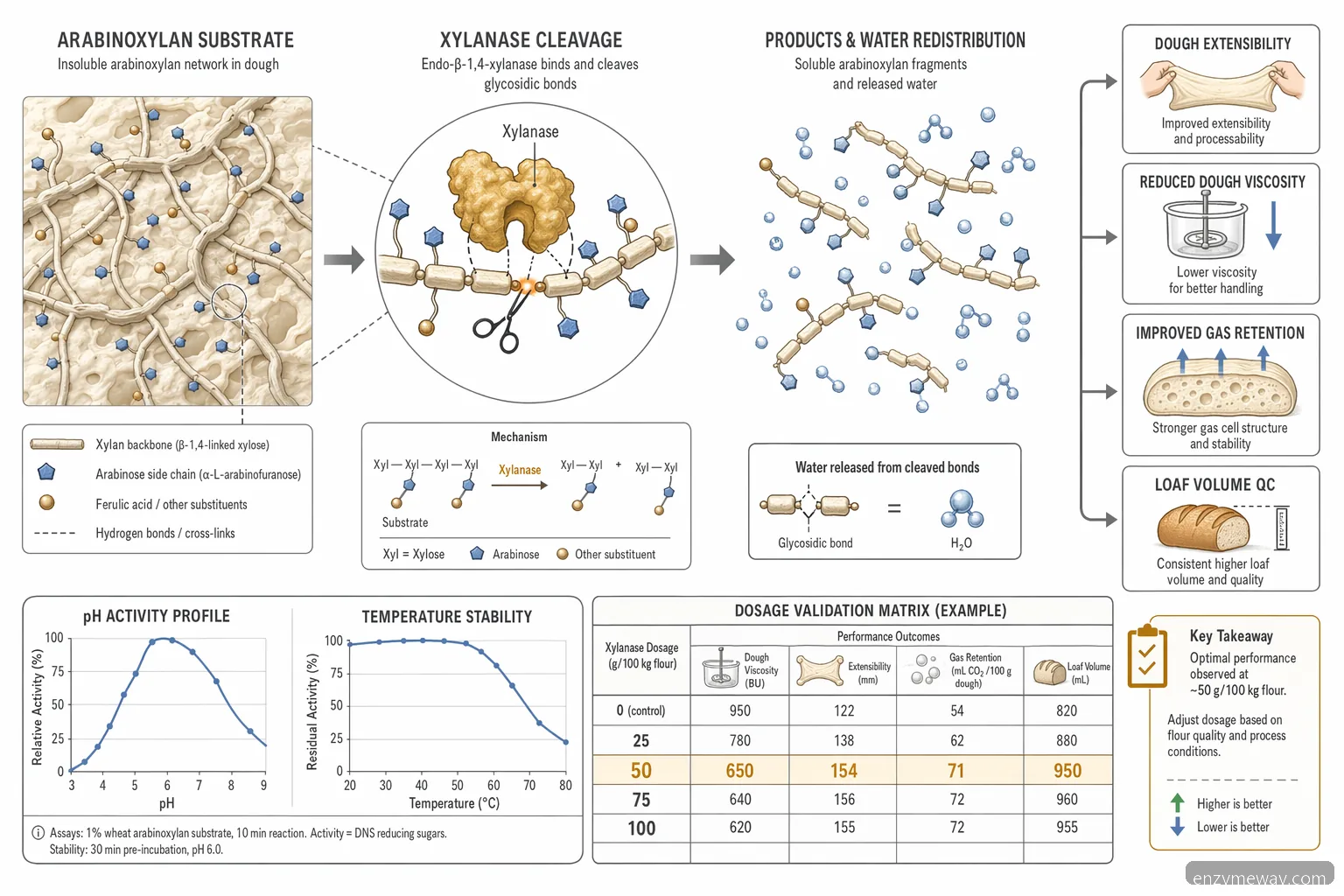
Xylanase, Baking Yeast, and Dough Improver Systems
A common formulation question is whether to choose xylanase or baking yeast. These ingredients do not perform the same function. Baking yeast produces carbon dioxide and fermentation metabolites, while xylanase modifies flour fiber fractions to influence dough structure and gas retention. In many industrial systems, xylanase enzyme for baking works alongside yeast, emulsifiers, ascorbic acid, amylase, and other dough improver components. The correct balance depends on product type and process severity. For short-time bread processes, the enzyme may help compensate for limited fermentation development. For long fermentation, excessive xylanase activity may reduce dough stability if the base flour is already weak. When optimizing, change one variable at a time and compare against a control formula. This approach helps determine whether the xylanase is improving volume and crumb or simply masking a yeast, mixing, or flour quality issue.
Xylanase is not a yeast replacement • Works best when balanced with yeast and improver chemistry • Overuse can increase stickiness or reduce dough tolerance
Pilot Validation and Bakery QC Checks
Before full production use, xylanase in baking industry applications should be validated in a pilot or production-equivalent trial. Start with a control bake, then test low, medium, and high dosage points within the supplier’s recommended range. Track dough absorption, mixing time, dough temperature, proof height, machinability, stickiness, and tolerance after floor time. Instrumental checks may include farinograph, extensograph, alveograph, texture analysis, water activity, and image-based crumb analysis where available. Finished-product evaluation should include loaf volume, symmetry, crumb grain, sliceability, softness over shelf life, and sensory panel review for texture. For automated lines, monitor divider scaling accuracy, dough pressure, sheeting stability, and pan release. The best dosage is not necessarily the highest volume result; it is the point that delivers consistent quality, line efficiency, and acceptable cost-in-use.
Run control, low, medium, and high dosage trials • Measure dough handling as well as finished bread quality • Confirm performance on actual flour lots and production equipment
Choosing a Xylanase Supplier for Baking
When selecting a xylanase supplier for baking, procurement and R&D teams should evaluate more than price per kilogram. Request a current Certificate of Analysis, Technical Data Sheet, Safety Data Sheet, recommended dosage range, storage conditions, activity definition, and test method. The supplier should clarify enzyme source, product form, carrier system, shelf life, and any relevant food regulatory status for the target market. For multi-site bakeries, batch-to-batch consistency and supply continuity are important qualification criteria. Ask for application guidance, sample quantities for pilot validation, and support for cost-in-use calculation. A reliable xylanase enzyme supplier for baking should also help compare activity-normalized performance, not simply provide a generic replacement. Final approval should include document review, sample testing, purchasing specifications, incoming QC requirements, and a plan for managing flour variability.
Request COA, TDS, SDS, dosage guidance, and activity method • Evaluate cost-in-use, not only unit price • Confirm regulatory suitability for the intended sales market • Qualify supplier consistency before production adoption
Cost-in-Use and Scale-Up Considerations
Cost-in-use for xylanase enzyme for baking should be calculated against measurable production benefits. These may include reduced dough handling issues, improved pan volume, fewer rejects, better slice quality, or reduced dependence on more expensive improver components. However, benefits should be demonstrated under routine production conditions, including flour lot changes and seasonal variation. During scale-up, confirm enzyme dispersion in dry premixes or liquid dosing systems, because poor distribution can create localized over-treatment and inconsistent dough behavior. Granulated products may suit dry blending, while liquids may be preferred for centralized dosing if mixing and sanitation are well controlled. Storage temperature, humidity exposure, and inventory rotation should follow the TDS. Set an internal specification for enzyme activity, appearance, odor, packaging integrity, and expiry review so incoming material remains suitable for bakery production.
Calculate cost per metric ton of flour or per finished unit • Validate dispersion in premix or dosing systems • Control storage, humidity, and first-expiry-first-out rotation
Technical Buying Checklist
Buyer Questions
Xylanase in baking helps modify arabinoxylans in flour, which can improve water distribution, dough extensibility, gas retention, loaf volume, and crumb structure. The result depends on flour quality, recipe design, fermentation time, and dosage. It should be validated in the full bakery process because excessive activity may create sticky dough or reduce tolerance.
A practical screening range is often 20–200 g of commercial xylanase product per metric ton of flour. Because enzyme products differ in activity and formulation, the supplier’s activity-based recommendation should take priority. Run control, low, medium, and high dosage trials, then select the level that balances dough handling, finished quality, and cost-in-use.
No. Xylanase and baking yeast have different functions. Yeast ferments sugars and produces carbon dioxide for dough leavening, while xylanase modifies flour arabinoxylans to influence dough rheology and gas retention. In most industrial bread systems, xylanase is used with yeast and other improver ingredients rather than as a substitute.
A qualified supplier should provide a Certificate of Analysis, Technical Data Sheet, Safety Data Sheet, activity definition, recommended dosage, storage conditions, shelf life, and relevant regulatory or allergen information for the target market. Buyers should also request pilot samples, batch consistency data, and technical support for activity-normalized comparison and cost-in-use analysis.
Compare trial batches against a control formula using the same flour, yeast, mixing profile, fermentation time, and baking conditions. Measure dough absorption, mixing behavior, stickiness, proof tolerance, loaf volume, crumb structure, softness, and sliceability. For high-speed lines, also monitor divider performance, sheeting stability, pan release, rejects, and consistency across production runs.
Request a Quote: Wholesale Supply for Bakeries, Improver Makers and Resellers
We supply xylanase to industrial bakeries, flour-improver and premix makers, ingredient distributors and resellers on a quote basis. The product on this site is Xylanase Enzyme Powder (EC 3.2.1.8): a light tan to brown powder in activity grades of 10,000 – 100,000 U/g, packed in 25 kg fiber drums or custom packaging. Prices are quoted per order.
To get a quote, send three things: the product and activity grade, the quantity per order or per month, and the destination country or port. Add your application and process conditions if you also want trial guidance with the quote.
Use the quote form on the home page or email hello@mail.enzymeway.com.
Xylanase for Research & Industry
Need Xylanase for your lab or production process?
ISO 9001 certified · Food-grade & research-grade · Ships to 80+ countries
Frequently Asked Questions
What is the main benefit of xylanase in baking?
Xylanase in baking helps modify arabinoxylans in flour, which can improve water distribution, dough extensibility, gas retention, loaf volume, and crumb structure. The result depends on flour quality, recipe design, fermentation time, and dosage. It should be validated in the full bakery process because excessive activity may create sticky dough or reduce tolerance.
What dosage of xylanase should industrial bakeries test first?
A practical screening range is often 20–200 g of commercial xylanase product per metric ton of flour. Because enzyme products differ in activity and formulation, the supplier’s activity-based recommendation should take priority. Run control, low, medium, and high dosage trials, then select the level that balances dough handling, finished quality, and cost-in-use.
Is xylanase a replacement for baking yeast?
No. Xylanase and baking yeast have different functions. Yeast ferments sugars and produces carbon dioxide for dough leavening, while xylanase modifies flour arabinoxylans to influence dough rheology and gas retention. In most industrial bread systems, xylanase is used with yeast and other improver ingredients rather than as a substitute.
What documents should a xylanase enzyme supplier for baking provide?
A qualified supplier should provide a Certificate of Analysis, Technical Data Sheet, Safety Data Sheet, activity definition, recommended dosage, storage conditions, shelf life, and relevant regulatory or allergen information for the target market. Buyers should also request pilot samples, batch consistency data, and technical support for activity-normalized comparison and cost-in-use analysis.
How should xylanase performance be checked during pilot baking?
Compare trial batches against a control formula using the same flour, yeast, mixing profile, fermentation time, and baking conditions. Measure dough absorption, mixing behavior, stickiness, proof tolerance, loaf volume, crumb structure, softness, and sliceability. For high-speed lines, also monitor divider performance, sheeting stability, pan release, rejects, and consistency across production runs.
Ready to source?
Turn This Guide Into a Supplier Brief Request a baking xylanase sample, COA/TDS/SDS, and formulation support for your pilot trial.
Contact Us to Contributehello@mail.enzymeway.com