Xylanase Production: Dosage, pH, Temperature and QC Troubleshooting
Troubleshoot xylanase production with practical dosage, pH, temperature, QC, COA/TDS/SDS review, pilot validation and cost-in-use guidance.
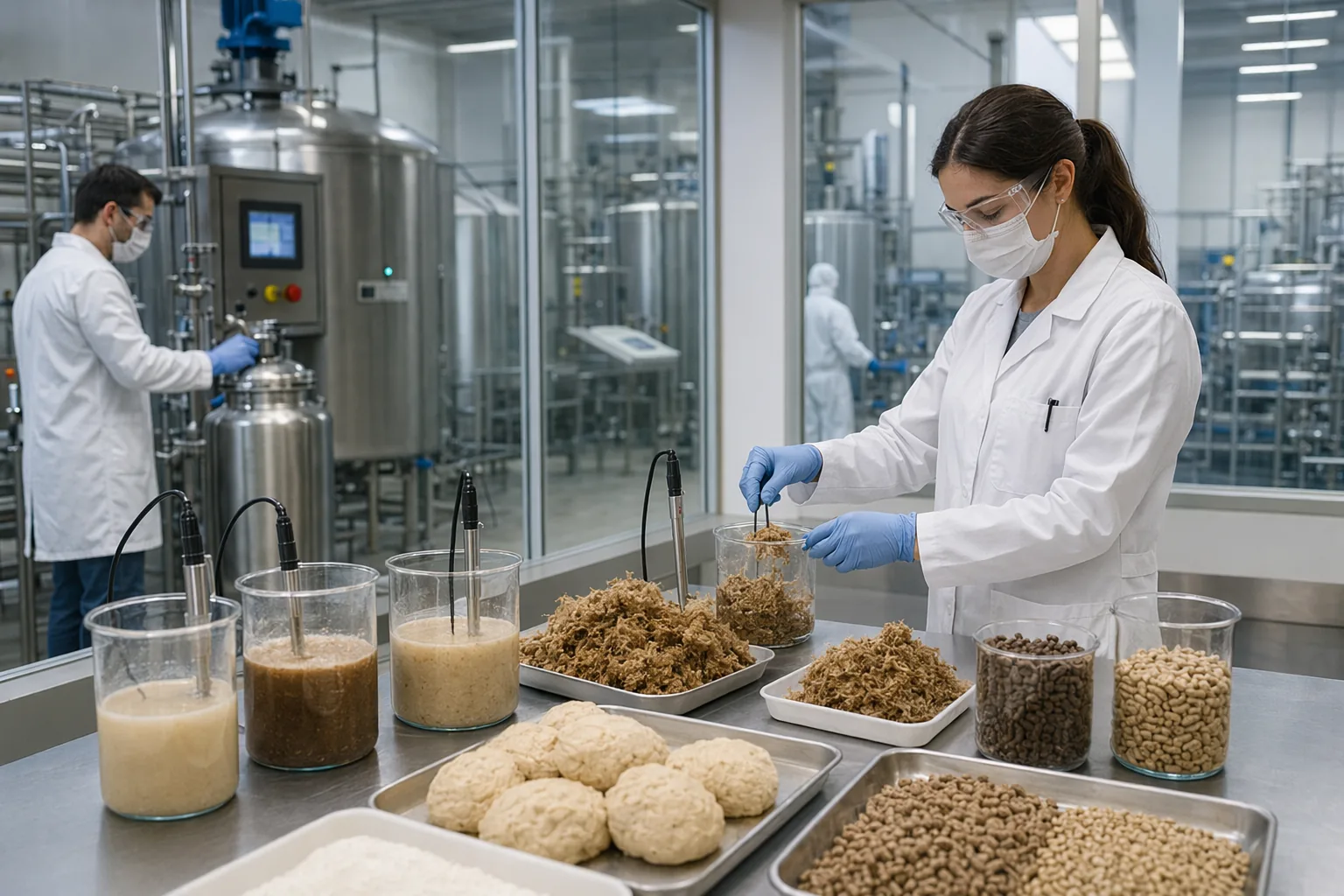
For industrial buyers, xylanase performance is not just about declared activity. Reliable results depend on matching enzyme grade, process pH, temperature, substrate, contact time and quality controls to the production line.
Why Xylanase Production Troubleshooting Starts with Conditions
Xylanase is used to hydrolyze arabinoxylans and other xylan-rich hemicelluloses in baking, animal feed, pulp and paper, and biofuel processes. When results drift, the cause is often not a “bad enzyme” but a mismatch among dosage, pH, temperature, moisture, mixing and contact time. A xylanase enzyme production batch may meet activity specifications on the COA, yet underperform if the production line exposes it to shear, heat, oxidants or pH outside its working range. Industrial buyers should begin with the supplier TDS, confirm the analytical activity method, and run a structured pilot before changing suppliers or increasing dose. Troubleshooting should compare enzyme lot, substrate lot, process data and final product KPIs together. This approach reduces over-dosing, prevents false rejection of good material, and supports stable cost-in-use across commercial production.
Check whether the declared activity method matches your internal assay. • Compare process pH and temperature against the TDS working range. • Review raw material variability before increasing enzyme dose.
Dosage Bands by Application and How to Optimize Them
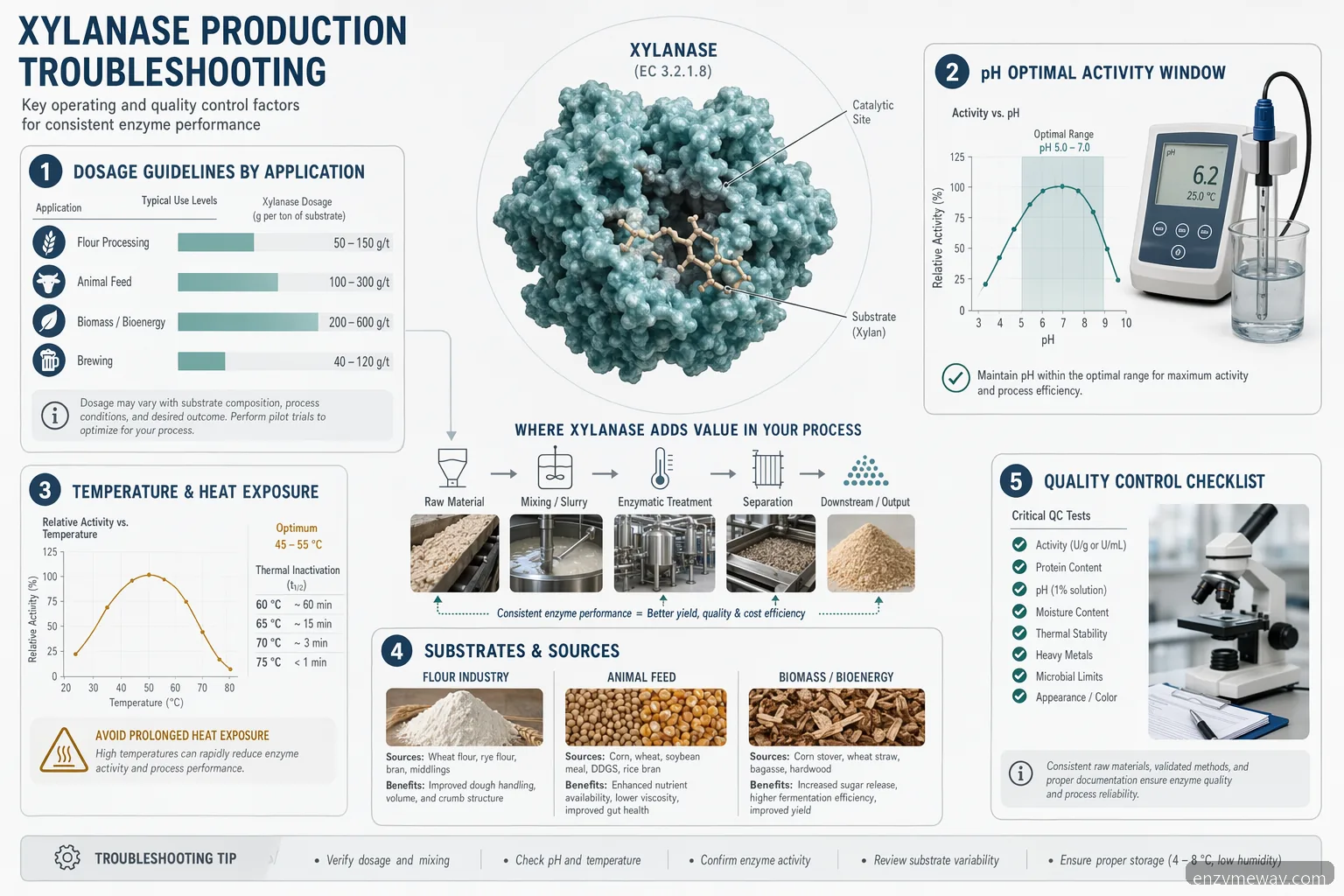
Xylanase dosage should be treated as a performance curve, not a fixed universal number. In baking, low ppm-level inclusion on flour weight is typical, with optimization based on dough handling, loaf volume, crumb structure and tolerance to over-softening. In animal feed, dosing is commonly expressed as activity units per kilogram of complete feed, adjusted for wheat, corn, rye, sorghum or by-product fiber content. In pulp and paper, xylanase is often dosed on oven-dry pulp to support brightness development, drainage or chemical reduction. In biofuel and biomass processing, dosage depends heavily on pretreatment severity, solids loading and whether endo-xylanase, beta-xylosidase or exo-acting support enzymes are needed. For procurement, request a recommended starting range, a maximum economic range and the supplier’s method for converting activity units to use-rate.
Baking: optimize against flour type, absorption and dough stability. • Feed: dose by activity units per kg feed and substrate fiber profile. • Pulp: evaluate on oven-dry pulp with brightness and drainage KPIs. • Biofuel: test with the actual pretreated biomass and solids loading.
pH Control: A Common Cause of Lost Xylanase Activity
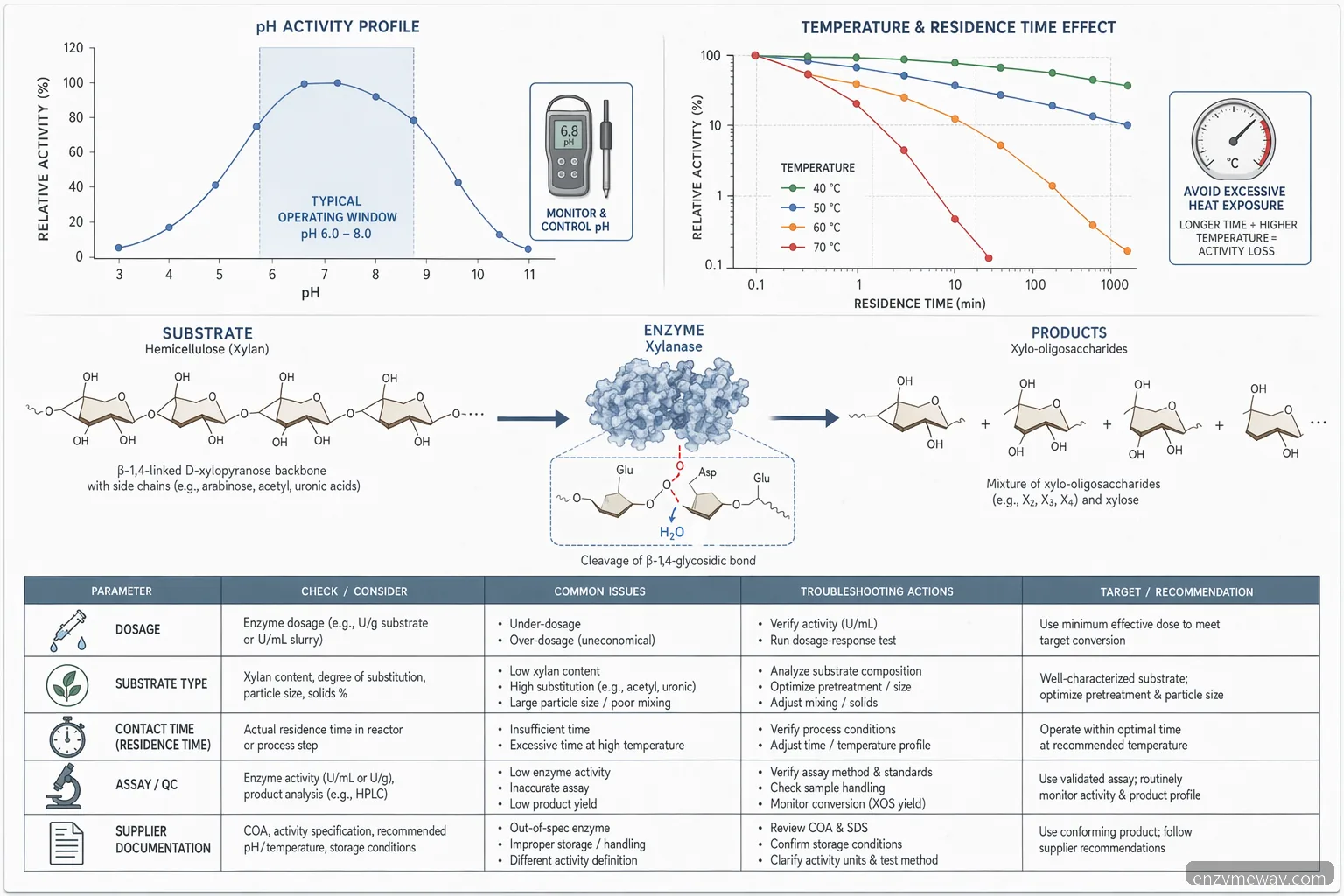
Many commercial xylanase enzyme products perform best in mildly acidic to near-neutral conditions, often around pH 4.5 to 7.0, but individual products may be narrower or shifted depending on microbial source and formulation. Xylanase enzyme production from bacteria can yield grades with different pH behavior than fungal-derived products, so assumptions based on one product should not be transferred to another. In baking, dough pH usually supports activity, but oxidants, salt, improvers and fermentation time can change results. In animal feed, pelleting does not provide much reaction time, so the relevant pH may be the digestive environment after ingestion. In pulp and paper, alkaline carryover, residual peroxide, chlorine dioxide residues or metal ions can suppress activity. Always measure pH at the point of enzyme contact, not only in the bulk tank or upstream recipe.
Measure real contact-point pH during production. • Confirm compatibility with oxidants, preservatives and process chemicals. • Avoid assuming fungal and bacterial xylanase share the same pH profile.
Temperature, Heat Exposure and Residence Time
Temperature troubleshooting requires separating reaction temperature from thermal survival. A xylanase may have good activity at 45 to 60°C but lose performance after extended exposure, drying, pelleting, steam conditioning or hot slurry holding. For baking, enzyme action usually occurs during mixing, resting and early baking before heat inactivation, so excessive proof time or high dose can create sticky dough. For animal feed, thermostable coated or granulated forms may be needed when conditioning temperatures reach 75 to 90°C, but actual survivability depends on moisture, retention time and shear. In pulp and paper, treatment temperature often sits in the 45 to 70°C range, depending on the enzyme grade and mill chemistry. In biofuel production, xylanase in biofuel production should be screened at process solids, temperature and pretreatment inhibitor levels, not only in clean buffer assays.
Distinguish optimum activity temperature from heat stability. • Use post-process activity recovery tests after pelleting or heating. • Pilot test at actual residence time, moisture and solids loading.
Raw Materials: From Flour and Feed Grains to Biomass
Substrate quality strongly affects xylanase production outcomes. Wheat flour arabinoxylan level, damaged starch, protein quality and seasonal grain variation can change baking response even at the same dose. Feed formulations with wheat, rye, barley, sorghum or high-fiber co-products may benefit differently depending on soluble and insoluble non-starch polysaccharides. Interest in sorghum straw for xylanase hyper production and biomass conversion highlights the importance of xylan structure, lignin content and pretreatment accessibility. For xylose production exo xylanase may be combined with endo-xylanase and beta-xylosidase activity to move beyond viscosity reduction toward fermentable sugar release. In pulp and paper, hardwood, softwood, recycled fiber and bleaching history all influence enzyme response. Buyers should share representative substrates with suppliers during qualification and avoid approving an enzyme using only ideal laboratory material.
Run trials on representative commercial substrates, not only lab-grade xylan. • Track seasonal grain or biomass changes against enzyme response. • Match enzyme activity profile to the desired endpoint: viscosity, fiber modification or sugar release.
Quality Documentation and Supplier Qualification
A reliable xylanase supplier should provide a current COA for each lot, a TDS with activity definition and use guidance, and an SDS covering safe industrial handling. The COA should identify enzyme activity, batch number, production date or retest date, and relevant physical specifications such as moisture, appearance or carrier information when applicable. The TDS should state recommended pH, temperature, dosage range, storage conditions and compatibility notes. For regulated applications such as food, feed, and pulp and paper, ask the supplier to explain applicable safety regulation xylanase production paper pulp considerations and intended-use boundaries without relying on vague claims. Qualification should also include packaging integrity, lot traceability, change notification, sample retention and complaint response. Strong documentation does not replace plant trials, but it helps buyers compare products objectively and reduce supply risk.
Request COA, TDS and SDS before commercial approval. • Confirm activity units and assay method are clearly defined. • Assess traceability, packaging, storage and change-control practices. • Use pilot validation before approving full-scale conversion.
Cost-in-Use: The Metric That Matters for Procurement
The lowest price per kilogram is rarely the best way to buy xylanase. A concentrated product may cost more per kilogram but deliver lower cost-in-use if it performs at a lower dose, survives the process, reduces chemicals or improves yield. In baking, value may come from consistent loaf volume, dough tolerance or reduced waste. In animal feed, the calculation should consider feed formulation flexibility, nutrient release assumptions and pelleting survivability. In pulp and paper, savings may include lower bleaching chemical demand, improved drainage or better fiber processing, subject to mill validation. In biofuel, the value case depends on sugar release, viscosity reduction, hydrolysis time and compatibility with cellulase cocktails. Procurement, technical service and production teams should define KPIs before trials so that purchasing decisions reflect measurable plant economics rather than enzyme unit price alone.
Compare products at equal performance, not equal weight. • Include waste, yield, energy, chemicals and downtime in economics. • Define pass/fail KPIs before supplier trials.
Technical Buying Checklist
Buyer Questions
Start with the supplier’s TDS dosage range, then design a small matrix around dose, pH, temperature and contact time. Use the actual plant substrate, not only purified xylan. Track both enzyme activity and application KPIs such as dough stability, feed viscosity, pulp brightness or sugar release. Compare results with the COA and keep retained samples for lot-to-lot review.
Lab assays often use clean buffers, controlled pH and ideal substrates. Production may include variable raw materials, oxidants, salts, steam, shear, inhibitors or short residence time. The enzyme may also be added too early or too late. Troubleshooting should measure pH and temperature at the real contact point and include a post-process activity check when heat exposure is involved.
Compare them at equal process performance, not equal kilogram dosage. Confirm activity units, assay method, pH range, temperature range, formulation type and recommended storage. Run pilot trials with the same substrate lot and production conditions. Then calculate cost-in-use, including yield, waste, energy, chemical savings, feed value assumptions or product consistency, depending on the application.
Neither source is universally better. Xylanase enzyme production from bacteria and fungi can produce different activity profiles, pH ranges, thermostability and side activities. The right choice depends on the substrate, process conditions and target result. Buyers should request technical data, safety documentation and pilot samples, then validate performance under commercial conditions rather than selecting by microbial source alone.
Request a lot-specific COA, a current TDS and an SDS. The COA should show activity and batch traceability. The TDS should define activity units, dosage guidance, pH and temperature ranges, storage and compatibility notes. The SDS supports industrial handling and risk assessment. For food, feed, pulp or biofuel use, also clarify intended application and relevant regulatory responsibilities.
Xylanase for Research & Industry
Need Xylanase for your lab or production process?
ISO 9001 certified · Food-grade & research-grade · Ships to 80+ countries
Frequently Asked Questions
What is the best starting point for xylanase production trials?
Start with the supplier’s TDS dosage range, then design a small matrix around dose, pH, temperature and contact time. Use the actual plant substrate, not only purified xylan. Track both enzyme activity and application KPIs such as dough stability, feed viscosity, pulp brightness or sugar release. Compare results with the COA and keep retained samples for lot-to-lot review.
Why does xylanase work in the lab but fail in production?
Lab assays often use clean buffers, controlled pH and ideal substrates. Production may include variable raw materials, oxidants, salts, steam, shear, inhibitors or short residence time. The enzyme may also be added too early or too late. Troubleshooting should measure pH and temperature at the real contact point and include a post-process activity check when heat exposure is involved.
How should buyers compare two xylanase enzyme products?
Compare them at equal process performance, not equal kilogram dosage. Confirm activity units, assay method, pH range, temperature range, formulation type and recommended storage. Run pilot trials with the same substrate lot and production conditions. Then calculate cost-in-use, including yield, waste, energy, chemical savings, feed value assumptions or product consistency, depending on the application.
Is bacterial xylanase better than fungal xylanase?
Neither source is universally better. Xylanase enzyme production from bacteria and fungi can produce different activity profiles, pH ranges, thermostability and side activities. The right choice depends on the substrate, process conditions and target result. Buyers should request technical data, safety documentation and pilot samples, then validate performance under commercial conditions rather than selecting by microbial source alone.
What documents should be required before purchasing xylanase?
Request a lot-specific COA, a current TDS and an SDS. The COA should show activity and batch traceability. The TDS should define activity units, dosage guidance, pH and temperature ranges, storage and compatibility notes. The SDS supports industrial handling and risk assessment. For food, feed, pulp or biofuel use, also clarify intended application and relevant regulatory responsibilities.
Ready to source?
Turn This Guide Into a Supplier Brief Ask EnzymeWay for xylanase samples, COA/TDS/SDS review, and pilot-trial support for your production line.
Contact Us to Contributehello@mail.enzymeway.com